
The Intel® Xeon Phi coprocessor
It has been a year since Intel introduced the first generation of Xeon Phi coprocessors. So what kind of beast is it? Let's find out.
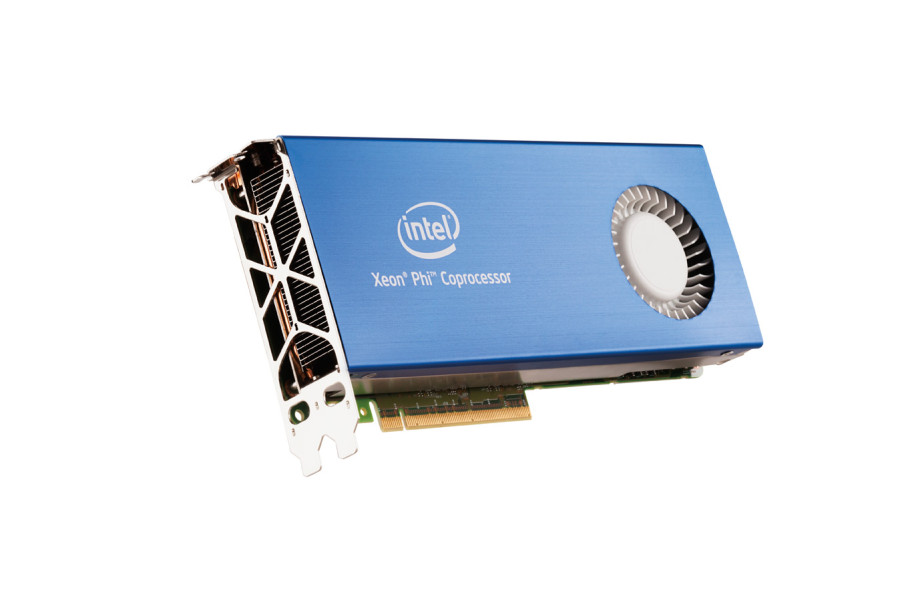
According to Wikipedia, Xeon Phi is a rebranding of Intel MIC (Intel Many Integrated Core Architecture), a many-core processor architecture Intel developed from its work on Larrabee, the Teraflops Research Chip and the Intel Single-chip Cloud Computer.
The second generation came out in 2013: in their top configuration the Xeon Phi 7120P/7120X coprocessors have 61 cores running 244 threads at 1.23/1.33 GHz (normal/turbo).
The offer sounds especially tempting for developers of multithreaded applications and cluster computing of all sorts, given that a Xeon Phi is a PCI Express card. Take a Xeon, add a couple of Phi cards, and you have yourself a supercomputer. Add a couple of big vendors shipping ready-made systems, SuperMicro, Dell, and it would seem you could even go to production.
Now the main question: what does a developer actually get? Let's read the Quick Start Guide on Intel's site:
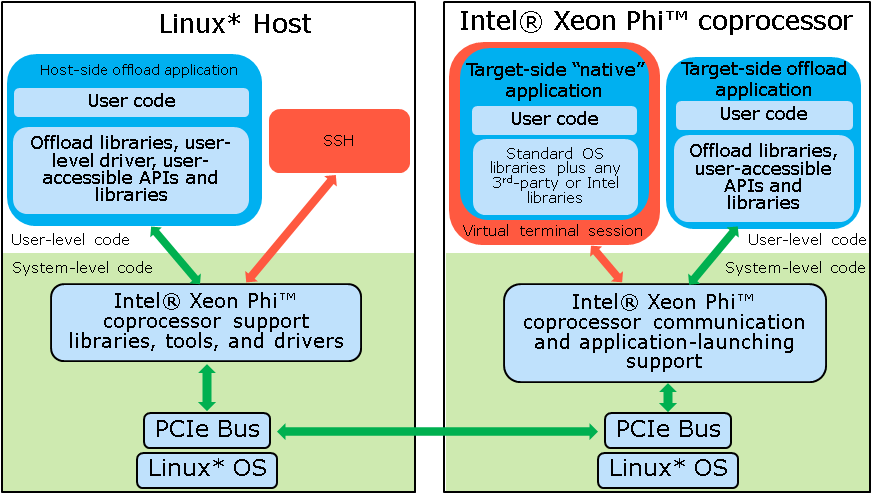
So:
- Take RHEL 6 (kernel 2.6.32-131 or later) or SLES 11 (kernel 3.0.13-0.27 or later); it seems no other OS will do
- Install the latest drivers from Intel and update the flash on the Phi itself
- Start the mpss service
- Buy, or download for free, the Software Development Tools components and install them
- Check with the sample (/opt/intel/composerxe/Samples/en_US/C++/mic_sample) that the card(s) work correctly
- Optionally turn on performance statistics collection
- Check the status (/opt/intel/mic/bin/micsmc)
- Ready to go
One comment struck me as interesting: "if your Phi(s) hang or stop working, stop, unload and restart the mpss service".
So how do you actually "get to" the coprocessor?
Route no. 1 surprised me a little: log in over SSH and you can run "many common Linux commands". File transfer, accordingly, is over scp.
IP addresses are assigned as 172.31.<coprocessor>.254, or as host aliases mic<coprocessor>. Like so:
weinberg@knf1:~> ssh mic0
[weinberg@knf1-mic0 weinberg]$ hostname
knf1-mic0
[weinberg@knf1-mic0 weinberg]$ cat /etc/issue
Intel MIC Platform Software Stack release 2.1
Kernel 2.6.34.11-g65c0cd9 on an k1om
Which raises the question: why would you want to get in there? It turns out we can run (ssh) our compiled binary right inside the Phi, after uploading it there (scp).
Route no. 2 is through the corresponding mic* binaries from the driver package.
Finally we get to development. Available to us:
- Compilers
- Intel C++ Composer XE 2013 for building applications that run on Intel® 64 architecture and Intel® MIC Architecture
- Intel® Fortran Composer XE 2013 for building applications that run on Intel® 64 architecture and Intel® MIC Architecture
- Libraries packaged with the compilers include:
- Intel® Math Kernel Library (Intel® MKL) optimized for the Intel® MIC Architecture
- Intel® Threading Building Blocks (Intel® TBB)
- Intel® Integrated Performance Primitive (Intel® IPP)
- Libraries packaged separately include:
- Intel® MPI for Linux* OS including Intel® Many Integrated Core (Intel® MIC) Architecture
- Intel® Trace Collector and Analyzer
- Intel® SDK for OpenCL* Applications XE 2013 available at: http://software.intel.com/en-us/vcsource/tools/opencl-sdk-xe
With a pile of compiler, linker and environment flags for actually running things.
The code itself:
float reduction(float *data, int size) {
    float ret = 0.f;
    for (int i=0; i<size; ++i) {
        ret += data[i];
    }
    return ret;
}
is optimised into:
float reduction(float *data, int size) {
    float ret = 0.f;
    #pragma offload target(mic) in(data:length(size))
    for (int i=0; i<size; ++i) {
        ret += data[i];
    }
    return ret;
}
or even into:
float reduction(float *data, int size) {
    float ret = 0;
    #pragma offload target(mic) in(data:length(size))
    ret = __sec_reduce_add(data[0:size]); //Intel® Cilk™ Plus Extended Array Notation
    return ret;
}
Which raises the question: what speed-up should you expect? Purely logically, on that same Xeon Phi 7120P/7120X with its 61 cores (and, presumably, a set of pipelines in each core), the speed-up on addition should be no less than 61× (thank you, Captain Obvious!).
Besides "speeding up" array addition there is real multithreading support for number crunching and much more, OpenMP included. It is also nice that you can write code that runs both with a Phi and without one.
What, in my opinion, is missing?
- Support for Java and "other languages", along with snippets and perhaps frameworks (not just C/C++ and Fortran)
- Support for operating systems other than Linux
P.S. The separate question of the price of the "entry-level card", 100 thousand roubles, we will leave outside the scope of this review.
P.P.S. The Phi's direct competitor is Nvidia Tesla
Originally published in Russian on LiveJournal.